
The Impossible Triangle
a.k.a. the Penrose Triangle
You scanned the shirt
One small step. One impossible structure. Look at the cubes, then look at the space beneath his foot.
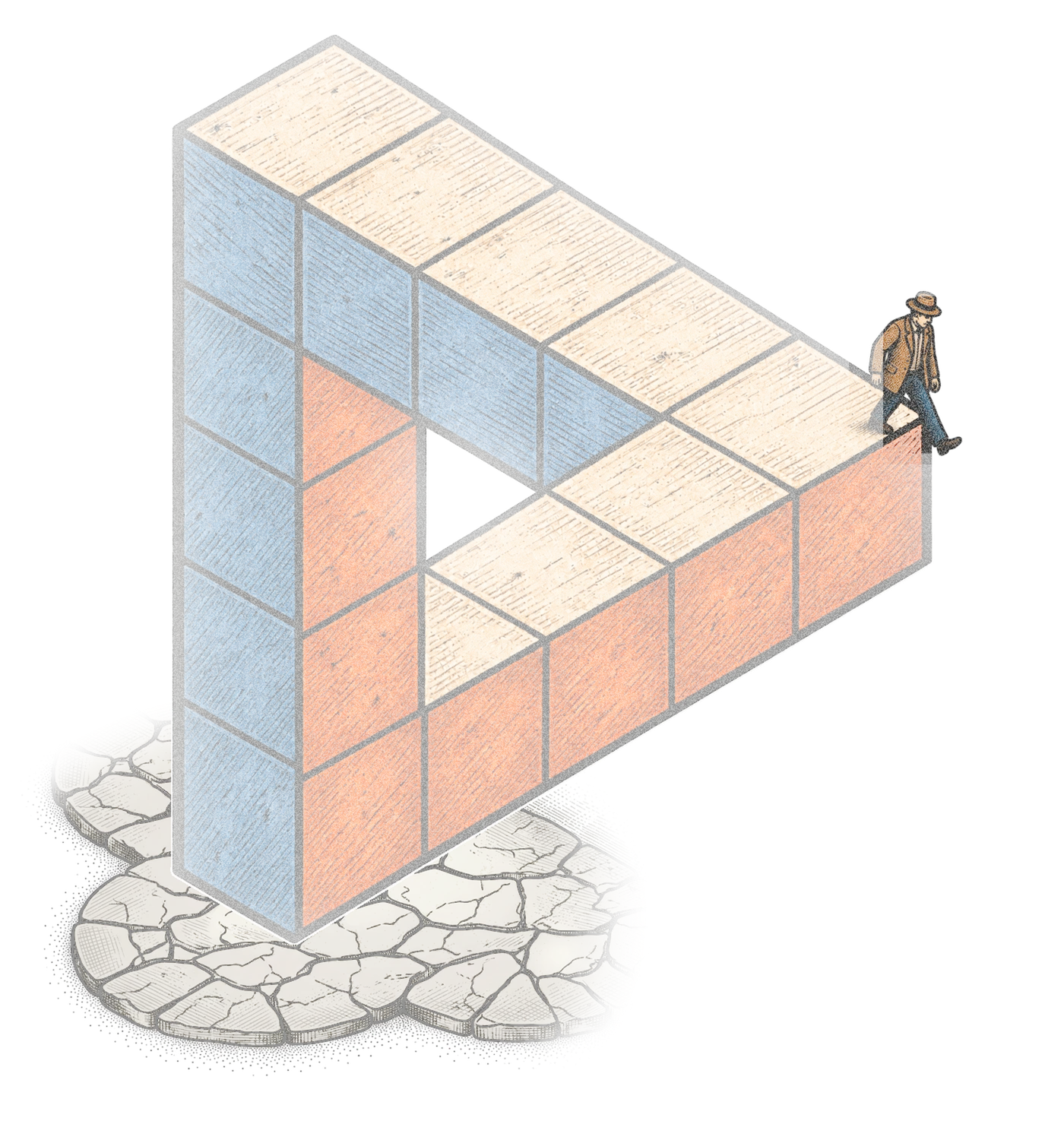
Each corner works. The whole triangle doesn’t. Trace the wooden cubes around the loop. At any one corner, the faces suggest an ordinary solid object. Follow them all the way around, though, and those local views cannot join up in three-dimensional space.
The blue, orange, and wood-toned faces help your eyes follow the structure — and make its conflicting depth cues harder to ignore. Your brain keeps trying to turn the flat drawing into something it could actually build.
Now watch his next step. The flagstones anchor the first two blocks, then fade away before reaching his corner. The impossible geometry makes that corner seem high in one reading and low in another. With no ground beneath his foot to settle the question, the distance of the drop stays uncertain.
Swedish artist Oscar Reutersvärd drew an early impossible triangle in 1934 using separate blocks. Lionel and Roger Penrose later popularized the form in a 1958 paper on impossible objects. It belongs to the same family of visual contradictions that inspired M. C. Escher’s impossible architecture.
Three sides. No sensible way down.
PuzzlingTees — shirts that make people look twice.